

By Sheng Peng
Before acquiring Taylor Hall, the Arizona Coyotes were on the way to the playoffs. After acquiring Taylor Hall, the Arizona Coyotes might be on the way to the Stanley Cup.
“Why not us?” asked Arizona GM John Chayka.
The Coyotes already boast a winning defensive structure. Now, in Hall, they’ve added a true game-breaker.
Let’s start with the defensive structure.
“Defending the puck hard is something, to win the Stanley Cup, you have to do as a team,” Arizona head coach Rick Tocchet said.
Not a lot of teams do it better than the Coyotes.
According to data from SPORTLOGiQ, Arizona allows the thirteenth-fewest Shots Against from the Inner Slot Per Game in the NHL (6.4). This, despite spending the second-most time in the league in their own end — opponents enjoy 7:03 of Offensive Zone Possession Time Per Game against the Coyotes.
“We try to give the outside,” Tocchet admitted. “The high-danger area is something we try to defend.”
This is a prime example from October against the Boston Bruins:
You’ll see these tenets in any clip of strong in-zone defense: Solid structure, along with defenders staying between the puck and the net.
Jake DeBrusk (74) comes up with the puck in the left corner. But standing between he and Darcy Kuemper is Jason Demers (55), then Oliver Ekman-Larsson (23) in the right corner, and finally, Lawson Crouse (67) at the point.
In terms of defensive structure versus the cycle, Arizona will usually send just one man after the puck, keeping their other four skaters around the slot. They also play a zone defense, as opposed to man-to-man, which you can see with how Demers hands off DeBrusk to Ekman-Larsson and so on.
Eventually, DeBrusk is able to exploit a structural breakdown — Matt Grzelcyk (48) gets behind Christian Fischer (36) — but Demers makes a good read and intercepts the pass.
“We stick to our structure, making sure we’re playing tight in the house,” Nick Schmaltz acknowledged. “Try to keep teams to the outside.”
A good stick is also crucial to the Coyotes’ defensive success.
The Coyotes lead the NHL in Blocked Passes Per Game in the Defensive Zone (31.9).
Here, Brad Marchand (63) beats Ekman-Larsson to the puck. Ekman-Larsson, however, has no fear, and hands off the always-dangerous Marchand to Christian Dvorak (18).
Critically, Dvorak keeps his stick on the ice — sometimes, you’ll see players in the defensive zone, holding their sticks in a more natural hands-at-their-hips position — but that’s how opposing passes find seams.
Dvorak also deftly keeps his lowered stick moving from left to right, to keep Marchand guessing.
“We want to make those passes through the seams very difficult,” Tocchet said. “We’ll allow passes maybe on the outside. But through the middle, we try to take those passes away.”
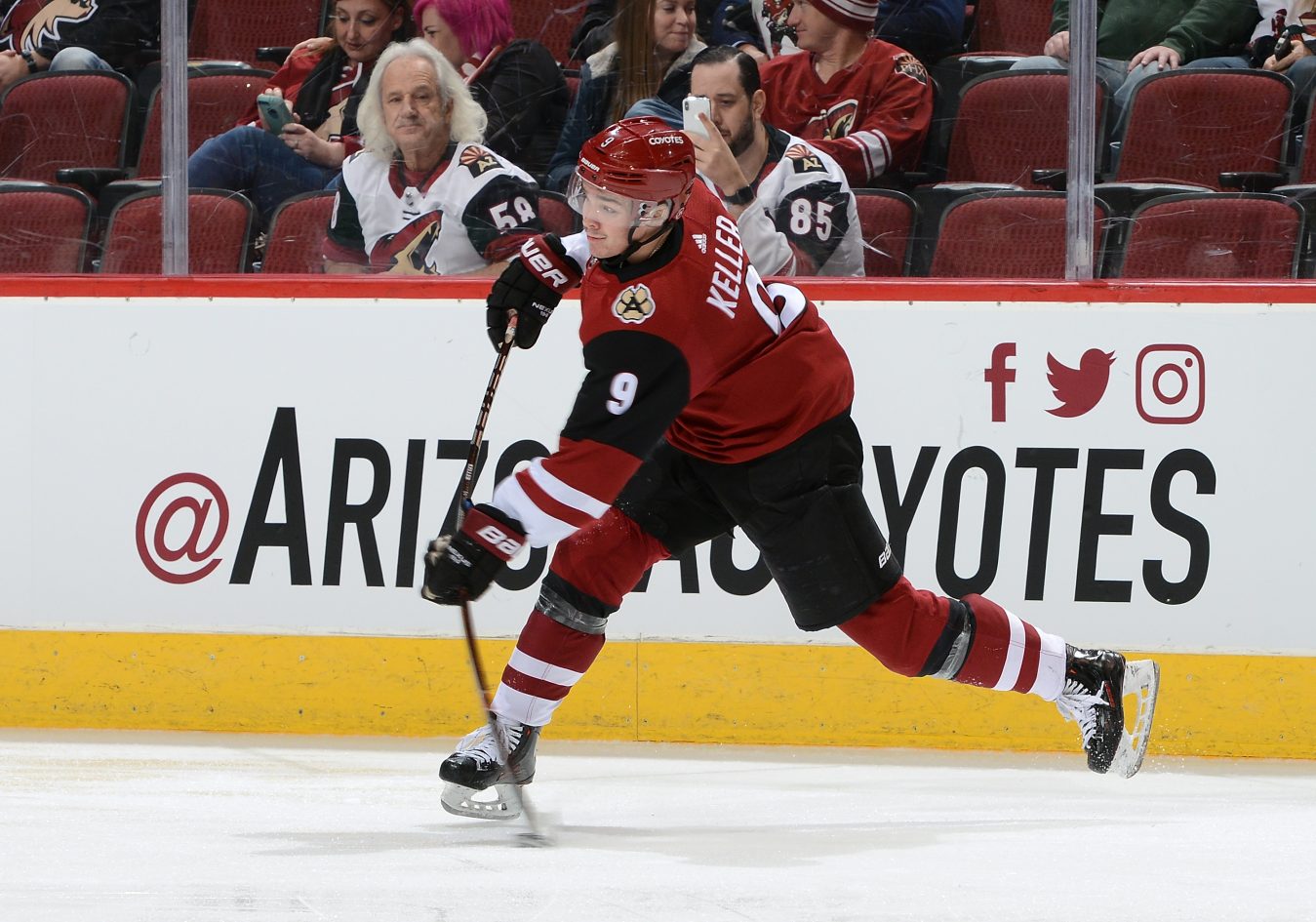
Clayton Keller echoed his coach: “Stick on puck is huge. You’re not always running, trying to hit a guy. Stick on puck is the most important thing.”
But ultimately, good defense comes down to will. You have to want to play good defense — and you show that desire by putting your body on the line, including having a willingness to block shots.
An unrelenting Vinnie Hinostroza (13) stays in front of David Pastrnak (88), taking a shot in the mid-section.
It’s the first thing Tocchet cited when asked why the Coyotes defend the slot so well: “The commitment of the players, the buy-in.”
Tocchet, who took over in the desert in 2017, recalled, “When I first got here, that’s one thing I really wanted to shore up, make sure they’re committed to defense.”
There’s no doubt that his players have bought in.
“We have a lot of guys who are smart players, who take pride in playing defense,” said Schmaltz.
Keller added, “Everybody’s always defending, knowing it leads to offense.”
That’s the attitude you want from a scoring forward like Keller.
Speaking of Arizona’s newest scoring star, Hall will inject instant speed into an already-deep line-up.
Only three players — Connor McDavid, Nathan MacKinnon, Jake Guentzel — have more Rush Chances Per Game than Hall (1.1).
Hall is also terrific in transition, he’s eighth in the league with 6.6 Zone Entries Per Game.
“Some players, they can’t drive, they have to chip it and dump it in,” Tocchet said. “He can drive people off, catch that piece of the ice inside the blueline, which is precious.”
Tocchet also admired Hall’s gumption: “He has that give-and-go game. He’s got a little Crosby in him, where he gives it to somebody, then he goes to an area, wants it back. He’s not afraid to go to the net.
“I love star players that go to the net. Crosby, Tavares. He’s not a perimeter player. That’s what I love about him.”
Hall (91) flashed that game-changing speed in his Arizona debut, breaking a tied game open on the forecheck:
It’s a parity-driven NHL. Two years ago, an expansion franchise made the Stanley Cup Final. Last year, a last-place squad in January hoisted the Stanley Cup in June.
This year, why not the Coyotes?