

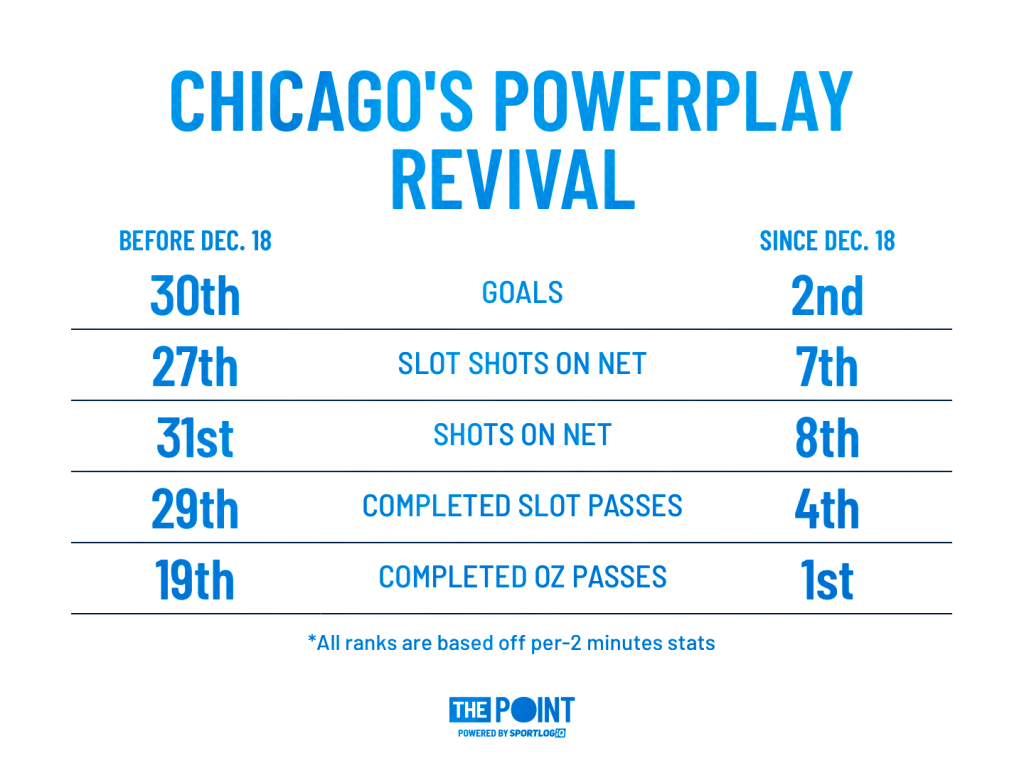
Yes, the Chicago Blackhawks have lost 4 straight including an 8-5 thumping last night against the Devils but, sliver lining, they did score another powerplay goal. Despite an abundance of talent, Hawks powerplay has been a mess for years, until recently. They’ve done a complete 180, going from one of the least dynamic teams in the NHL to one of the best at moving the puck quickly and efficiently. We wrote about their struggles with the man-advantage barely a week into the season and it was one of the reasons that led to the firing of longtime coach Joel Quenneville. They didn’t do much better under Jeremy Colliton at first and fell down to a putrid 11.4% in the middle of December. Then, something clicked. Since December 18, the Blackhawks have the hottest powerplay in the NHL and convert on a blistering 36.1% of their opportunities, easily best in the NHL. It’s not just puck luck going their way either, the process has fundamentally changed for the better.
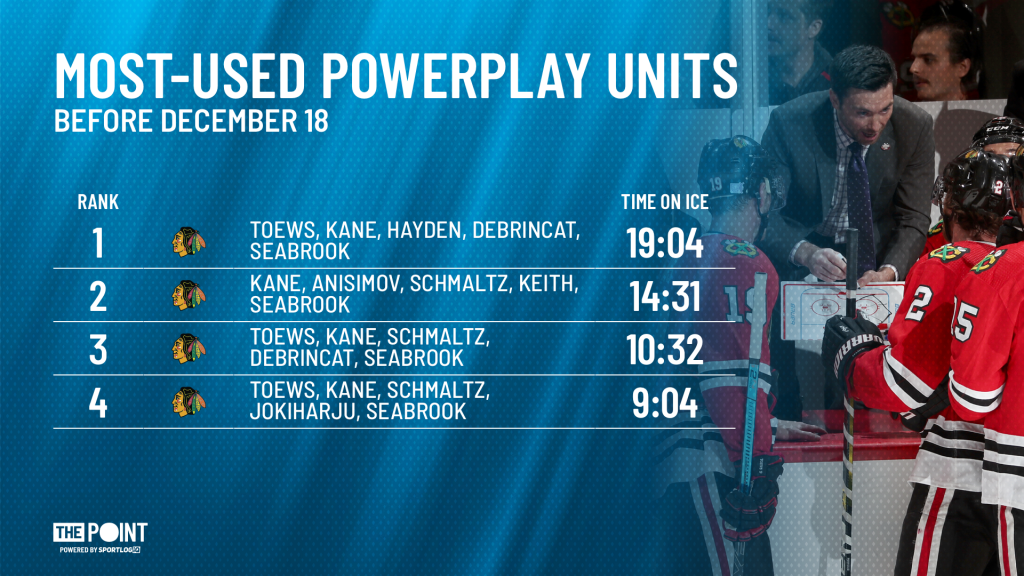
The first and most obvious difference with Chicago is the changes to their top unit. Prior to December 18, the Blackhawks played 20 different powerplay unit variations for at least 2 minutes as they were looking for ways to get going. Four played at least nine minutes, yet none topped the 20-minute mark despite the team spending 178 minutes up a man over 35 games. Essentially, they consisted of Patrick Kane and Brent Seabrook, with the other three players shuffled constantly.
That’s a massive amount of turnover and it obviously makes it hard for the players to build chemistry when they’re dealing with new linemates night in night out. Since their hot streak has started, they’ve gone to the other extreme. They’ve found one five-man unit that works and they haven’t touched it since.
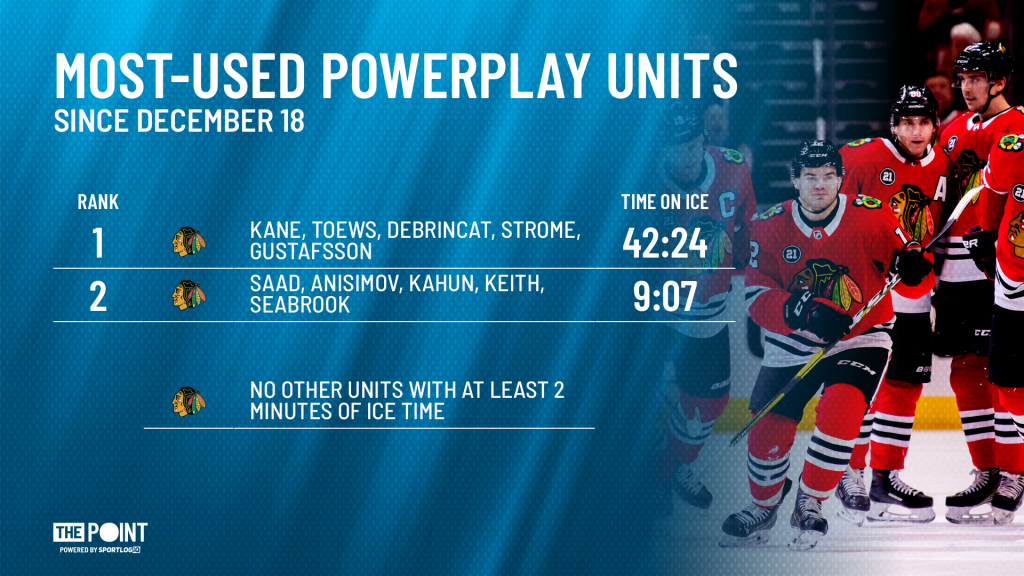
Consistency has been key and the players agree. “We’ve been together for a while, so I think that’s kind of the nice part about it,” Patrick Kane said. “We know each other’s positions. We know where we’re going to be when we’re in trouble.” That last part was evident when Kane found DeBrincat with a no-look pass for a goal against the Avs in late December.
But consistency alone does not make a successful powerplay. This unit is fundamentally and stylistically completely different to anything the Hawks played earlier on the year. In October and November, it was maddening to watch them play. Their only strategy seemed to be Patrick Kane handling the puck on the left wall looking to create all by himself before either taking a shot or giving up and passing to the blueline for a Brent Seabrook one-timer. Now, the puck flows way more when you watch them play. It’s not stuck on Kane’s stick for ages at a time anymore. Even though he actually has the puck a little longer in total, he is passing it a lot more often and so are his teammates.
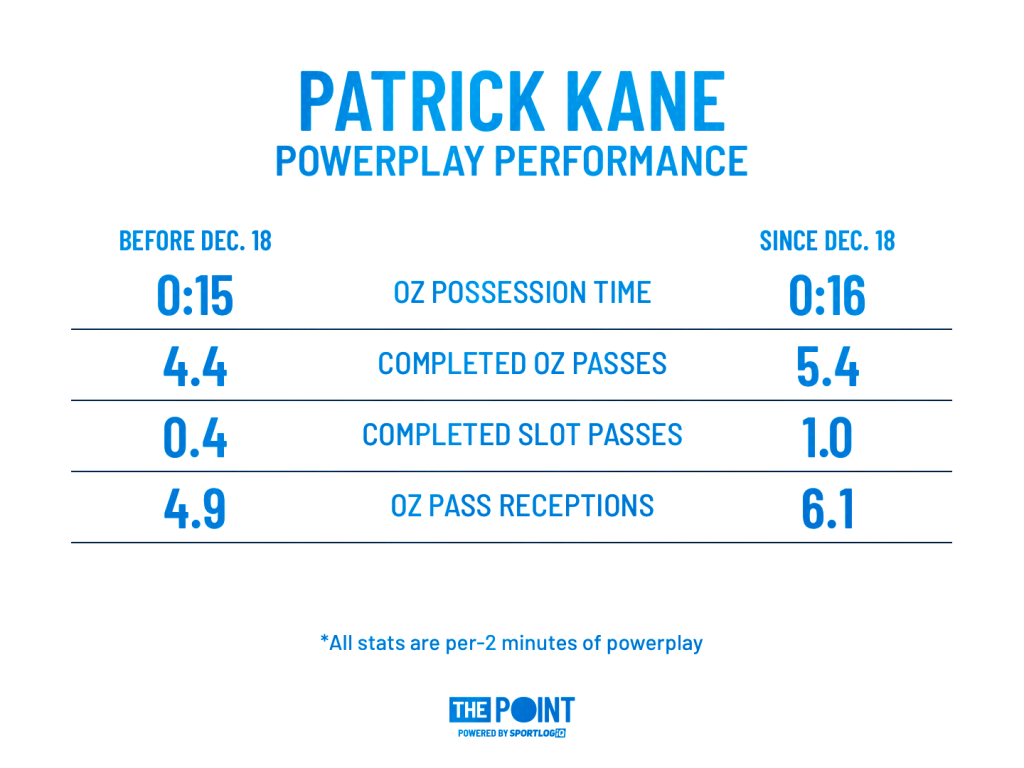
Prior to the resurgence, his 4.4 completed OZ passes per-2 led the team, with no other Blackhawk topping four. Now, despite a significant increase in passes per-2, Kane is second on the team behind Gustafsson (5.7). The Hawks are focusing on moving the puck often to force the penalty killers out of position and open up better shooting lanes. They lead the league in powerplay passing since, as shown in the first graphic.
The shot distribution has also changed for the better. Seabrook has scored just two powerplay goals in each of the last two seasons, yet only Kane attempted more powerplay shots than him prior to the shakeup. There is no way that a defenseman not known for scoring should ever take up that much of your powerplay offense. Their new top unit has turned around the shot distribution the right way.
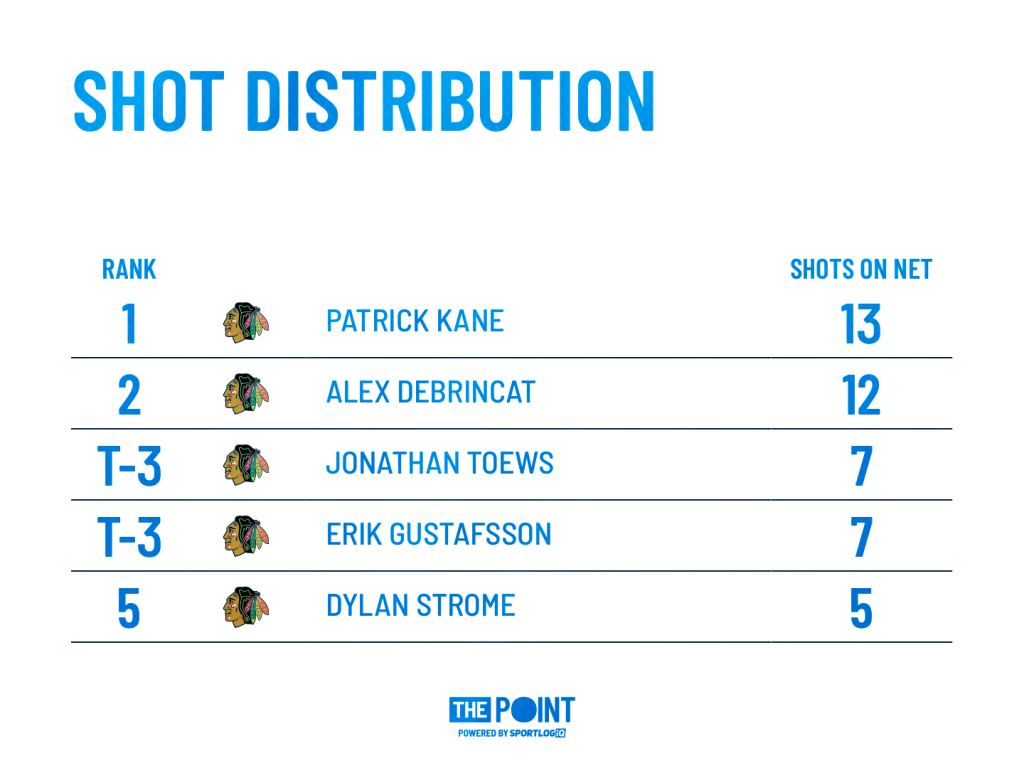
It may sound groundbreaking, but it seems like having your top forwards shoot more often than a defenseman who scored more than nine goals once in 13 years has worked out. Who would’ve thought.
“Less time hanging onto the puck on the wall in the attacking end / teeing up point shots and more of a commitment to getting pucks to the middle of the ice. This is what’s needed to improve Chicago’s powerplay.” This is what we wrote about Chicago’s powerplay a week into the season and, surprise surprise, this is exactly what they’ve done. Their passes to the slot are up, and so is the shot quality. Kane isn’t hogging the puck on the wall forever anymore and teeing up the point isn’t the primary option. Any type of playoff push is probably a stretch, but fixing a powerplay that’s been broken for a year and a half is a big win for Jeremy Colliton in his first NHL head coaching gig.