


Special to the Winnipeg Free Press
After breaking down why I think the Winnipeg Jets are inoculated against an Edmonton Oilers style collapse this season, the question becomes how can these Jets improve on last season? That’s a tall order for a team that recorded 114 points in the regular season and made it to the Western Conference Final but looking at the Jets most see a clear Stanley Cup contender, so what needs to change to get them over that hump?
Before we can figure out weaknesses, it might be helpful to examine what made them such a daunting team for opponents to face off against.
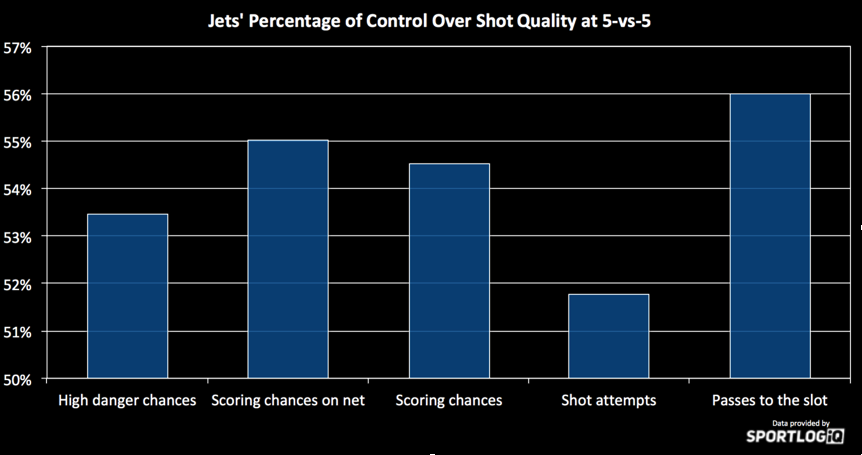
The Jets were one of the most potent offensive teams in the NHL last season and accomplished that not with shot volume, but by manufacturing high-quality scoring chances. The Jets did outshoot their opponents, though not by as much as the usual top end teams in the league because they regularly passed up shots from the perimeter of the ice, where the chances of a shot beating a goaltender are just four percent.
They focused on more than just shot location as well, leading the league in the percentage of their scoring chances that were preceded by a pass at 5-vs-5, at 51.9%. That dominance in passes to the slot came from a versatile group of forwards led by Blake Wheeler who are as dangerous shooting as they are passing, which freezes opponents and forces them to make a choice; to play the shot or the pass. Every team has a couple players who can do this; the Jets have more than a couple, and even their lower end players have bought into this goal.
On the opposite end, they were one of the most stingy defensive teams in the NHL, boxing teams out of the slot with phenomenal success, especially the inner slot or high danger area.
So what can a team that exhibits such dominance in the most important areas of the game improve to better their chances of lifting the Stanley Cup in June?
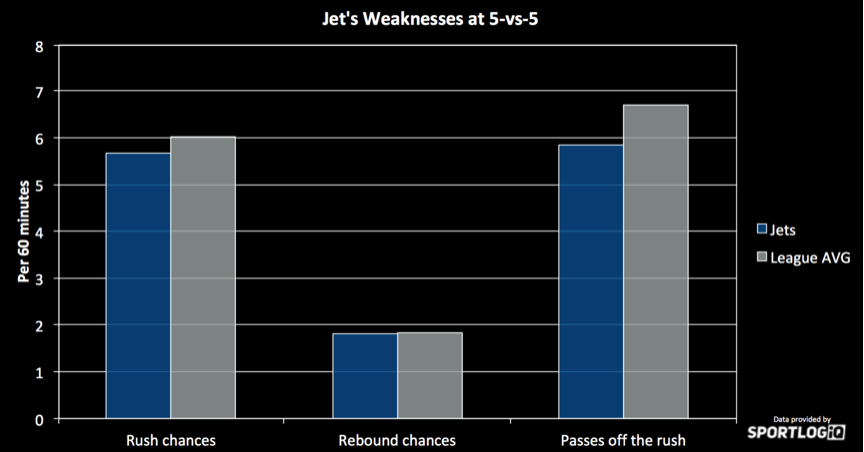
In combing through the data for the Jets, it’s slim picking to find glaring weaknesses, they are a structurally sound team that is at least competitive in essentially every area, so at 5-vs-5 I decided to look at a few areas where they’re slightly below average as areas to improve.
The Jets were the second-highest scoring team in the NHL last year after the Lightning and the second-most offensively potent team at 5-vs-5 after the Penguins, but they actually have room to grow.
Likely by design, the Jets played a low event game off the rush last season, not attacking that way often, and also not conceding many chances off the rush. With a year’s worth of confidence in Connor Hellebuyck, a younger blue line, and players like Kyle Connor and Patrick Laine a year older though, I think this is an area where they can begin to exploit opponents more often.
Attacking off the rush carries an inherent risk: if you turn over the puck you’re vulnerable to a counterattack, but the Jets are so good at defending they can afford to take more risks offensively. There’s really no reason why they should be a below average team in rush chances or passes off the rush this season, they have the talent, and it could be a change that propels them to be the league’s top offensive team.
Another area that the Jets were a hair below average in was generating scoring chances off of rebounds, which is a bit confusing since they were a top team in recovering their own rebounds in the offensive zone, they just struggled to turn those recoveries into second-chance opportunities. This is an area I expect to see Connor take a big step in this season.
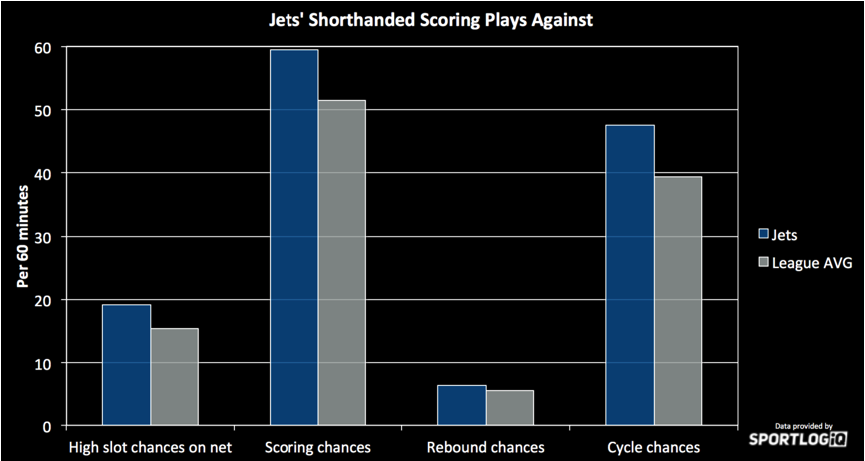
Shorthanded, the Jets’ defensive dominance starts to dissipate a little bit, as they were victimized for more scoring chances than every team except for the Montreal Canadiens last year.
The Jets still protect the inner slot well while down a man, and they’re still one of the top teams at blocking passes into the slot, but they leave a pretty sizeable gap in the high slot, which is the second-most dangerous area on the ice, and allowed more scoring chances on net from there last year than any other team.
The battle level in front of their own net could also improve, as the Jets left Hellebuyck a little vulnerable to second-chance opportunities if he wasn’t able to smother the rebound.
The cycle seems to be the biggest problem for the Jets while shorthanded, they remain excellent at breaking up forechecks and force teams to either dump the puck in or stay out of the middle on zone entries, so it’s all about keeping strong in their positions while teams attempt to break down the penalty killing unit with passing and cycling the puck.
Even with these weaknesses, the Jets’ penalty kill was pretty decent last regular season, but it was a bit more exploitable in the playoffs, so I would wage this is an area they would like to improve.
(Photo by Frederick Breedon/Getty Images)